
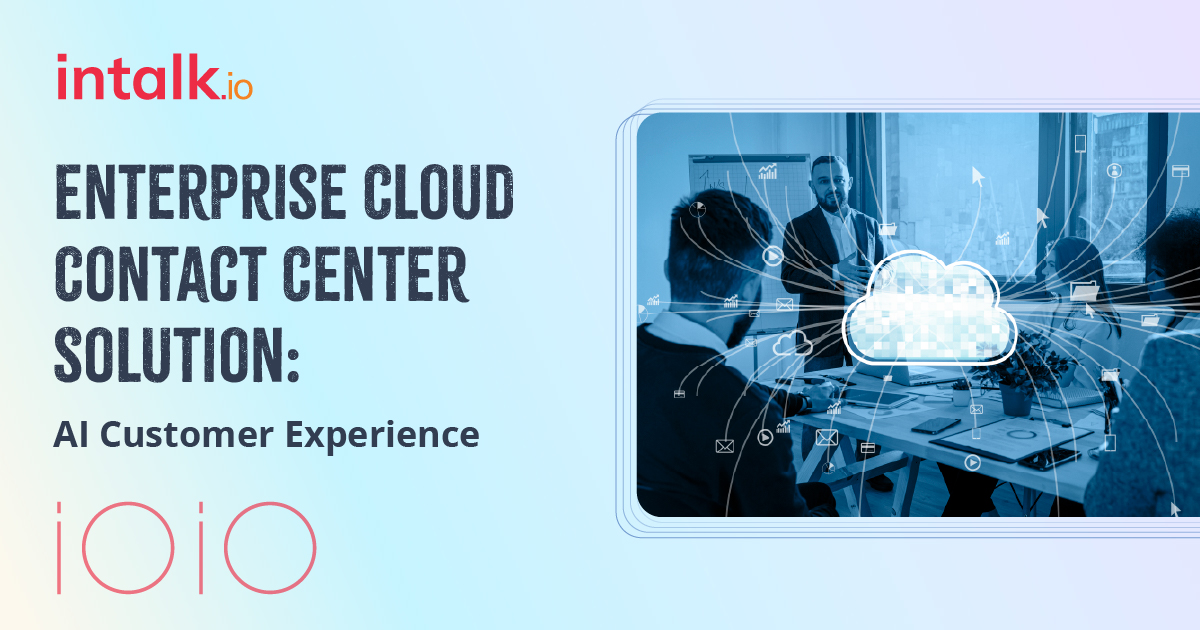

This blog explores what makes a cloud contact center solution enterprise-ready, including scalability, system integration, governance, and real-time operational visibility. It also explains how AI customer experience strategies and the AI Voice Agent support high-volume customer interactions across enterprise environments.
A cloud contact center solution becomes enterprise-ready when it supports scale, system integration, and real-time decision-making across high-volume environments. Enterprise teams rely on these systems to manage distributed operations, maintain service consistency, and deliver AI customer experience through tools such as the AI Voice Agent.
At intalk.io, this definition is shaped by real-world deployments where scale, latency, and continuity influence every design decision.
This readiness reflects architecture, integration depth, governance, and the ability to sustain AI customer experience at scale.
Cloud Contact Center Solution Architecture For Enterprise Scale
Enterprise environments require systems that handle variable demand without disrupting ongoing operations. A cloud contact center solution achieves this through distributed infrastructure that supports concurrent interactions across regions and channels.
Scalability in this context extends beyond capacity. It includes session stability, call quality, and consistent response times during peak loads. Infrastructure must sustain voice, chat, and messaging interactions while maintaining system responsiveness. This foundation allows enterprises to expand operations while preserving service quality.
Unified Customer Context Across Channels
Customers interact through multiple channels during a single journey. Voice, chat, email, and messaging each contribute to the overall experience. Enterprise-ready systems maintain a unified view of these interactions.
A cloud contact center solution consolidates interaction data into a shared context layer. Agents receive visibility into previous conversations, transaction history, and intent signals. This continuity reduces repetition and supports accurate responses. A unified context layer also strengthens AI customer experience, since AI models rely on consistent data to interpret intent and guide interactions effectively.
Integration With Enterprise Systems
Contact centers operate within a broader ecosystem that includes CRM platforms, ticketing systems, analytics tools, and business applications. Integration determines how effectively a contact center contributes to overall operations.
Enterprise-ready platforms support structured integration through APIs and managed connectors. Data flows between systems in real time, allowing updates to reflect across workflows without delay. This connectivity ensures that customer interactions remain aligned with business processes and operational data.
AI Customer Experience And The Role Of The AI Voice Agent
Enterprises increasingly adopt AI to enhance efficiency and improve interaction quality. A cloud contact center solution must support this shift through built-in capabilities for automation and intelligence.
An AI Voice Agent plays a central role in handling inbound interactions, capturing intent, and guiding customers through defined processes. Within an enterprise environment, this capability operates alongside human agents, contributing to workload distribution and consistent handling of routine queries.
AI systems also support routing decisions, sentiment awareness, and post-interaction analysis. These capabilities form the basis of a structured AI customer experience strategy that evolves through continuous learning.
Security And Governance Frameworks
Enterprise adoption depends on strong security and governance practices. A cloud contact center solution must align with organizational policies for data handling, access control, and system usage.
Security operates through encryption of data in transit, controlled access frameworks, and defined permission structures across users and roles. Governance extends to auditability, where system actions and interactions are recorded for review and compliance purposes.
These frameworks ensure that customer interactions are handled within established operational and regulatory standards.
Real-Time Insight In A Cloud Contact Center Solution
Enterprises require continuous visibility into contact center performance. Real-time dashboards, reporting tools, and analytics systems provide insight into interaction volumes, response times, and customer behavior.
A cloud contact center solution enables leaders to monitor operations as they unfold. This visibility supports immediate decision-making, including staffing adjustments, routing refinements, and process improvements. Analytics also contribute to AI customer experience by identifying patterns across interactions and informing system enhancements.
Agent And Supervisor Enablement
Enterprise readiness includes the ability to support both agents and supervisors with effective tools. Agents require unified workspaces that present customer context, interaction history, and guidance within a single interface.
Supervisors benefit from oversight tools that provide performance metrics, quality monitoring, and coaching insights. An AI Voice Agent can support this environment by handling routine interactions and allowing agents to focus on more complex conversations.
This balance strengthens overall team efficiency and supports consistent service delivery.
Adaptability To Evolving Business Needs
Enterprise environments change continuously. New services, regulatory updates, and customer expectations shape how contact centers operate. A cloud contact center solution must support this evolution through configurable workflows and modular capabilities.
Adaptability allows organizations to refine routing logic, update interaction flows, and introduce new channels without disrupting existing operations. This flexibility ensures that the system remains aligned with business priorities over time.
The Enterprise Standard For Cloud Contact Centers
A cloud contact center solution becomes enterprise-ready when it supports scale, integration, governance, and continuous improvement within a single environment.
At intalk.io, this foundation is built to support AI customer experience through unified data, real-time orchestration, and voice-led interactions powered by the AI Voice Agent. The result is a system designed to handle enterprise complexity while maintaining clarity across every customer interaction.
Enterprise readiness reflects the ability to operate reliably under pressure, adapt to change, and deliver connected experiences across every interaction.