
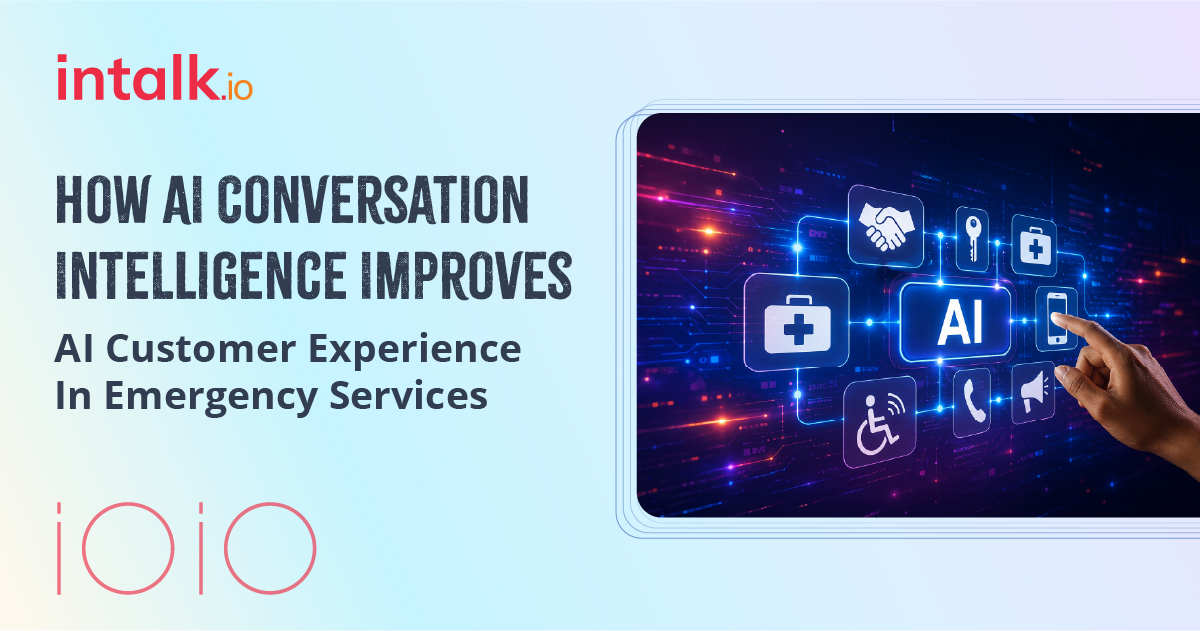

Emergency calls contain information about location clarification, caller intent, questioning patterns, transfers, escalations, and communication gaps. Much of that information remains difficult to examine when teams rely on individual call reviews. Conversation intelligence allows emergency service teams to analyze conversations at scale, identify recurring patterns, and use those findings to improve QA, training, workflows, and response processes. Insight AI from intalk.io brings transcription, sentiment analysis, conversation insights, compliance monitoring, and dashboard-based reporting into this process.
A dispatcher asks for the caller’s location. The caller gives the name of a nearby building. The dispatcher asks again. The caller provides a street name, followed by another clarification before the location becomes clear enough to proceed.
One call like this may be entirely reasonable. The operational question appears when the same exchange happens hundreds or thousands of times.
The same applies to transfers, repeated questions, escalations, and calls that require additional clarification before moving into the appropriate workflow. These details already exist inside emergency call recordings. The challenge is finding the recurring patterns within them.
In this setting, AI customer experience extends beyond measuring satisfaction; it includes how clearly information is established, how efficiently the interaction moves between stages, and where communication creates additional work for the response team.
Where Emergency Calls Reveal Process Gaps
Emergency call handling depends on establishing useful information quickly. Location, incident type, urgency, caller condition, and other details can emerge in different ways depending on the situation and the person making the call.
Emergency calls involve variables that are difficult to capture through conventional QA alone: how dispatchers establish critical information, where conversations require repeated clarification, which workflows create additional handoffs, and where similar incidents begin to follow different response paths. When these patterns are analyzed across the call population, operations teams can see where communication and process design are adding friction to an otherwise human-led response.
When the same signal appears across a large number of calls, it becomes possible to investigate what is causing it. Repeated location clarification could lead a team to review questioning sequences or the information available to dispatchers. Frequent transfers within one incident category could point toward a routing issue or missing context at the point of handoff.
The individual call provides the event. The pattern across calls provides something operations teams can investigate.
What Thousands Of Calls Reveal That Individual Reviews Cannot
Quality teams have long relied on call reviews to evaluate emergency interactions. Sampling allows supervisors to assess individual calls, coach personnel, and check adherence to established procedures.
The limitation is the amount of the operation that can actually be examined.
A team reviewing a selection of calls can identify what happened in those interactions. It has a harder time determining how often a particular issue occurs across the full call population or whether the same pattern appears across teams, shifts, locations, or incident categories.
Insight AI from intalk.io approaches this through conversation analysis at scale, giving teams a broader view of AI customer experience across the emergency operation rather than limiting assessment to selected recordings.
A team investigating extended call handling, for example, can examine conversations associated with longer interactions, identify repeated questioning, and compare how similar incidents were handled across different parts of the operation.
The review moves from individual examples toward evidence about the wider process.
How AI Customer Experience Applies To Emergency Operations
AI customer experience in emergency services operates within a very different context from commercial customer support.
A caller may be distressed, confused, unfamiliar with their location, or unable to provide information in a structured way. Conversation analysis can help teams examine how those interactions develop while keeping front-line calls human-led.
Sentiment signals can identify calls where distress or frustration rises during the interaction. Searchable transcripts can show where clarification becomes repetitive. Conversation analysis can reveal whether particular workflows consistently generate additional questions, transfers, or escalations.
For QA teams, these patterns can support targeted coaching. For training teams, they can highlight recurring communication issues. For operations leaders, they can provide evidence for reviewing workflows and escalation procedures.
The quality of an emergency interaction therefore becomes something teams can examine across the operation rather than only within individual recordings.
Where AI Voice Agent Fits Around Emergency Services
An AI Voice Agent can support the communication that happens around an emergency response once critical assessment and decision-making remain with trained personnel. Post-incident updates, appointment or follow-up notifications, status communications, information requests, and other defined administrative interactions can be handled through automated voice workflows when the use case and escalation rules are clearly established.
For example, after an incident has been logged, an AI Voice Agent can contact a person with a status update, communicate a defined next step, or collect information required for a subsequent administrative process. If the interaction requires judgement outside the configured workflow, it can be transferred to an appropriate human team.
This creates a clearer boundary for AI in emergency environments. Human responders remain responsible for situations where urgency, assessment, reassurance, or judgement are central to the interaction, while AI Voice Agents can take on structured communication around the response.
These interactions can also contribute to the wider conversation dataset. Teams can analyze where people request clarification, which updates generate follow-up contacts, and where automated communication creates additional questions, giving operations teams evidence to improve notification workflows and post-emergency processes.
Turning Conversation Patterns Into AI QA And Training Decisions
The value of conversation intelligence becomes clearer when its findings reach the teams responsible for improving call handling.
A QA team may identify repeated clarification around location information and use those calls for targeted coaching. A training team may discover that dispatchers handling a particular incident category encounter the same communication difficulty and adjust the relevant training material. Operations leaders may find that repeated transfers are concentrated around a particular workflow and investigate the routing process behind them.
The same conversation data can support compliance and audit activity. Searchable records make it easier to locate interactions requiring review and examine whether defined procedures or required disclosures were followed.
The starting point changes as well. Instead of selecting a small group of calls and asking whether they represent the wider operation, teams can identify a recurring pattern across the call population and then examine the conversations behind it.
That gives QA, training, compliance, and operations teams a common evidence base.
Turning Emergency Conversations Into Operational Insights driven by AI
Emergency service organizations already generate the raw material for this analysis every time a call is handled.
Insight AI from intalk.io brings transcription, sentiment analysis, conversation insights, compliance monitoring, and reporting into a single conversation intelligence layer. Teams can examine calls across the operation, identify patterns that warrant investigation, and connect those findings to the work of QA, training, compliance, and operations.
A single call may show that a dispatcher had to clarify a location three times. A larger body of analyzed calls can show whether that same issue appears repeatedly within a particular incident type, location, shift, or workflow.
That distinction matters because recurring communication patterns can point toward changes in training, questioning procedures, routing, escalation rules, or workflow design.
The conversation becomes a source of operational evidence rather than a recording that is reviewed only when a particular call requires investigation.
How Conversation Intelligence Strengthens Emergency Response Over Time
The value of conversation intelligence in emergency services extends beyond reviewing how an individual call was handled.
When teams can see recurring clarification, transfer, escalation, and communication patterns across their interactions, they gain a clearer basis for examining the processes behind those patterns.
For organizations exploring AI customer experience in emergency operations, the useful question is how much information already exists inside the conversations being handled every day and how effectively that information can be turned into better training, stronger QA, and better operational decisions.